Last updated: October 11, 2026
For most van builds, the best vacuum under $100 is a compact cordless stick or handheld in the 20V class — the Black+Decker FLEX cordless stick around $70–100 is the best all-rounder, and the Bissell AeroSlim handheld around $45–60 is the best for fast cab and dash touch-ups — because they run off their own battery instead of your house bank. If you have shore power or a genuinely large inverter, a corded canister such as the Eureka Mighty Mite ($70–95) delivers far more suction and dust capacity for the money, but it will punish a 100Ah lithium bank. The deciding factor in a van is almost never suction — it is watts, storage footprint, and what you have to keep buying.
- Quick comparison: affordable vacuums that fit van life
- Best overall: Black+Decker FLEX 20V MAX cordless stick
- Best budget: Bissell Featherweight corded stick
- Best for quick touch-ups: Bissell AeroSlim cordless handheld
- Best for deep cleans when you have hookups: Eureka Mighty Mite canister
- Best if you already run power tool batteries: Ryobi ONE+ 18V handheld
- How to choose: the numbers that actually matter
- Which one for your situation
- Frequently Asked Questions
Quick comparison: affordable vacuums that fit van life
| Pick | Best for | Key specs (manufacturer figures, rounded) | Typical price |
|---|---|---|---|
| Black+Decker FLEX 20V MAX cordless stick | Best overall for a full-time van | 20V battery, roughly 0.5–0.6 L dust cup, ~3 lb, 15–20 min runtime, converts to handheld | $70–100 |
| Bissell Featherweight corded stick | Best budget / occasional use | Corded AC, ~4 lb, ~15 ft cord, roughly 0.5 L dust cup, no battery to age out | $35–50 |
| Bissell AeroSlim cordless handheld | Best for quick cab, dash and seat cleanups | Under 1.5 lb, ~12 min runtime, dust cup under 0.2 L, USB-C charging | $45–60 |
| Eureka Mighty Mite canister | Best deep clean with hookups or a big inverter | ~12 A motor (roughly 1,400 W), ~9 lb, ~20 ft cord, bag capacity around 2 L | $70–95 |
| Ryobi ONE+ 18V handheld | Best if you already carry Ryobi batteries | 18V, ~2.5 lb, 10–15 min per 4Ah pack, shares batteries with your drill and inflator | $40–70 tool-only |
| Dirt Devil Scorpion handheld | Best ultra-budget backup | Corded AC, ~4 lb, small dust cup, crevice tool included | $25–35 |
Best overall: Black+Decker FLEX 20V MAX cordless stick
See also: Best Black Friday Dresser Deals • Best Wooden Train Sets for Toddlers and Kids
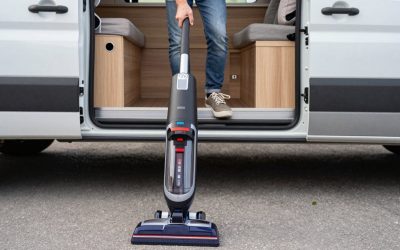
This is the shape that makes sense in a van: a stick that breaks down into a handheld, hangs on a hook behind the sliding door, and never asks your electrical system for anything. Per the manufacturer’s spec sheet it runs 15–20 minutes per charge depending on mode and battery size, and the dust cup is in the 0.5–0.6 L range — enough for a week of sand, dog hair, and crumbs in a 70-square-foot living space.

Bissell 2033M Featherweight Stick Lightweight Bagless Vacuum and Electric Broom with Crevice Tool for Hard Floors and Carpets, Black
Included for 'Best Vacuums Under $100' because the listing specifies Black, details this guide uses to compare options.
View on Amazon
Shark Rocket Corded Stick Vacuum, Carpet & Hard Floors, Gray/Orange, HV301
Included for 'Best Vacuums Under $100' because the listing specifies Carpet & Hard Floors and Gray/Orange, details this guide uses to compare options.
View on Amazon
Eureka Whirlwind Bagless Canister Cleaner NEN110A Lightweight Corded Vacuum for Carpets and Hard Floors, Blue
Included for 'Best Vacuums Under $100' because the listing specifies Blue, details this guide uses to compare options.
View on AmazonWho it suits: full-timers without consistent shore power, anyone with a 100–200Ah lithium bank who does not want to run an inverter for chores.
Main trade-off: runtime fades as the battery ages, and a replacement 20V pack costs roughly $40–60 — which is a meaningful fraction of the vacuum’s price. The dust cup is also small enough that you will empty it after every serious clean.
Best budget: Bissell Featherweight corded stick
At roughly $35–50, the Featherweight is the cheapest vacuum that still picks up grit properly, and it has one advantage cordless models cannot match: nothing to wear out except the belt. No battery to replace, no charging routine, no runtime anxiety. It weighs around 4 lb, has a cord in the 15 ft range, and converts to a handheld for stairs and bench seats.
Who it suits: weekend campers, people who clean once a week, and anyone parked at hookups most nights.
Main trade-off: it is a corded appliance. Run it through an inverter and you are pulling roughly 1,000–1,200 W, which is the number that trips BMS cutoffs on many 100Ah lithium batteries (more on that below).
Best for quick touch-ups: Bissell AeroSlim cordless handheld
The AeroSlim weighs under 1.5 lb and charges over USB-C, which means you can top it up from a 12V USB outlet or a power station without thinking about it. Runtime is around 12 minutes per charge, and the dust cup is deliberately tiny — under 0.2 L.
Who it suits: the “sand in the footwell, crumbs on the mattress” problem. Keep it in the cab and use it daily.
Main trade-off: it is not a floor vacuum. Twelve minutes of runtime and a cup you empty twice per session make it a supplement to a stick vacuum, not a replacement.
Best for deep cleans when you have hookups: Eureka Mighty Mite canister
The Mighty Mite is the value pick for actual cleaning power: a roughly 12 A motor, a long cord, and a bag capacity near 2 L, which means you empty it monthly rather than daily. It also reaches places a stick cannot — under the bed platform, into the heater vent, along the ceiling fan housing.
Who it suits: anyone who spends most nights on shore power, or who has a 2,000 W+ inverter and a 200Ah+ bank.
Main trade-off: bags are a consumable you have to stock and store, and at roughly $8–12 for a three-pack, a full-timer should budget about $20–30 a year. It also weighs around 9 lb and takes up real cabinet space.
Best if you already run power tool batteries: Ryobi ONE+ 18V handheld
If your van already carries Ryobi ONE+ batteries for a drill, inflator, or fan, the handheld vacuum is the cheapest sensible option: $40–70 tool-only, and it shares packs you already own. Expect 10–15 minutes per 4Ah battery, and the ability to swap in a fresh pack mid-clean.
Who it suits: builders, anyone with a tool-battery ecosystem already aboard.
Main trade-off: tool-only pricing is misleading if you don’t own the batteries — a kit pushes you over $100. Suction is also modest compared with a corded canister.
How to choose: the numbers that actually matter
1. Power draw decides everything
Do the math before you buy. A corded vacuum rated at 10 A and 120 V draws 1,200 W. Through an inverter at roughly 90% efficiency, that becomes about 1,330 W of DC load — which at 12.8 V nominal is roughly 104 A. Many 100Ah LiFePO4 batteries have a 100 A continuous BMS limit, so the vacuum may shut the battery down on startup surge. Even when it works, the runtime is short: a 100Ah battery holds about 1,280 Wh, so 1,280 × 0.9 ÷ 1,200 ≈ 57 minutes at 100% depth of discharge, or about 46 minutes at a healthier 80% DoD.
| Vacuum type | Typical draw | Runtime per “tank” | What it costs you |
|---|---|---|---|
| Corded canister (12 A) | ~1,400 W AC / ~1,550 W DC through inverter | ~40 min from a 100Ah LiFePO4 at 80% DoD | ~120A DC draw; will trip many 100A BMS units |
| Corded stick (10 A) | ~1,200 W AC / ~1,330 W DC | ~46 min at 80% DoD | ~104A DC draw — right at the limit |
| Cordless stick (20V, 2.0Ah) | ~150 W from its own 40 Wh pack | 12–20 min per charge | ~0.04 kWh; effectively free from a 12V socket |
| 12V car vacuum (cigarette plug) | ~100–120 W | Unlimited while the socket is live | ~8–10A from a 15–20A fused circuit |
The practical rule: if your house bank is 100Ah, buy cordless. If it is 200Ah or more with a 2,000 W inverter, a corded canister becomes viable as a once-a-month deep-clean tool.
2. Dust capacity sets your cleaning rhythm
Handheld dust cups run 0.1–0.2 L, cordless sticks 0.5–0.6 L, and bagged canisters around 2 L. In a van, a 0.5 L cup is roughly one full-van pass including the bed platform; a 2 L bag is a month. Capacity matters less than you think — what matters is whether emptying it is a 20-second job or a bag you have to remember to reorder.
3. Attachments and reach
Two attachments earn their storage space: a crevice tool for seat rails, heater vents, and the gap between the mattress and the wall, and a soft upholstery brush for the mattress and cushions. Extension wands matter more in a van than in a house, because ceiling vents and overhead cabinets are awkward to reach from a crouch. Check that the wand is at least 20 inches when assembled.
4. Replacement costs: the part nobody budgets for
- Filters: $8–15 each, replaced or washed every 3–6 months. Bagless vacuums run roughly $20–60 a year in filters if you replace rather than wash.
- Bags (canister): $8–12 per three-pack; a full-timer uses roughly six to eight bags a year, so $20–30 annually.
- Batteries: $40–60 for an OEM 20V pack, typically good for 2–4 years of van use. Aftermarket packs are cheaper and usually weaker.
- Belts: $5–8, and the first thing to fail on a corded stick vacuum.
Over three years, a $45 corded Featherweight plus belts and filters lands near $90 total. A $90 cordless stick plus one replacement battery lands near $150. The cordless premium is real, but it buys you independence from shore power — which in a van is usually the whole point.
5. Storage footprint
Measure the gap before you buy. A cordless stick with the wand removed is typically 18–22 inches long and can hang on a hook; a canister is a 9 lb box that needs a shelf. In a short-wheelbase build, that difference often decides the purchase on its own.
Which one for your situation
- 100Ah battery, no shore power, full-time: cordless stick (Black+Decker FLEX) plus a small handheld for the cab.
- Weekend trips, hookups most nights: Bissell Featherweight — cheapest total cost of ownership.
- 200Ah+ bank and a 2,000 W inverter, pets aboard: corded canister for monthly deep cleans, cordless for daily.
- Already carry Ryobi batteries: the ONE+ handheld, tool-only.
- Tight budget under $50: corded stick, and accept that you clean only when plugged in.
Frequently Asked Questions
Can I run a corded vacuum off my van’s inverter?
Sometimes, but check the numbers first. A 10–12 A vacuum pulls roughly 1,200–1,400 W AC, which becomes about 1,330–1,550 W DC through an inverter — around 104–120 A at 12.8 V. Many 100Ah lithium batteries cap continuous discharge at 100 A, so the vacuum may shut the battery down on startup. You need a 2,000 W+ inverter and a bank rated for at least 150 A continuous discharge to do this reliably.
Is cordless or corded better for van life?
Cordless wins for most builds because it runs off its own battery rather than your house bank, and it stores on a hook instead of a shelf. Corded wins on raw suction, dust capacity, and total cost of ownership — there is no battery to replace at $40–60. If you are on shore power most nights, corded is the better value; if you boondock, cordless is the only option that does not fight your electrical system.
How often do I need to replace vacuum filters?
Plan on every three to six months with regular van use, or sooner if you are picking up fine dust, sand, and ash. Washable filters should be rinsed and fully dried — putting a damp filter back in a vacuum is one of the most common causes of musty smells and lost suction. Replacement filters generally run $8–15 each, so budget $20–60 a year for a bagless machine.
What is the best vacuum for pet hair in a van?
For pet hair specifically, prioritize a motorized brush roll and a crevice tool over raw wattage, because hair wraps around brush bars and mats down into upholstery. A corded canister with a turbo brush handles embedded hair best when you have power; a cordless stick with a motorized head is the practical daily option. Empty or cut hair off the brush roll after every few uses — it is the single biggest cause of reduced suction.
Should I choose a bagged or bagless vacuum?
Bagless is better for van life in most cases because you never have to hunt down replacement bags while travelling, and there is nothing extra to store. Bagged canisters hold far more debris — roughly 2 L versus 0.5 L — and empty less often, which suits full-timers who clean a lot. If you go bagged, carry a spare three-pack, since bag sizes are model-specific and not sold everywhere.
How do I store a vacuum in a small van?
Look for a stick vacuum that separates into a handheld, since the two pieces store in different places — the body in a cabinet, the wand on a hook or bungee behind a door. A canister needs a dedicated shelf and should be strapped down, because a 9 lb box becomes a projectile in an emergency stop. Whatever you choose, store it empty: debris left in a dust cup for weeks in a hot van is what makes vacuums smell.