Last updated: November 13, 2026
- Best Kids Scooters for Safe, Smooth Rides
- Quick picks by age and riding ability
- How wheel size changes the ride
- Deck size, height, and steering stability
- Brake types: what to choose
- Decision guide for real family situations
- Foldability and van-life storage
- Durability and ownership costs
- Buying checklist before you pay
- Bottom line
Best Kids Scooters for Safe, Smooth Rides
The best kids scooters match the rider’s height, balance, and confidence to the right wheel size, deck, weight limit, steering system, fold, and brake—not simply the scooter with the largest wheels or lowest price.
Quick picks by age and riding ability
See also: Best Automatic Pool Covers 2026: 7 Top Picks • Best Avalanche Airbag Packs 2026: 7 Top Picks
| Rider and situation | Best scooter type | Recommended specifications | Why it fits |
|---|---|---|---|
| About 2–5 years, first scooter | Three-wheel lean-to-steer scooter | 120–125 mm front wheels, 70–80 mm rear wheel, 25–35 kg limit, 25–30 cm deck | Two front wheels create a broad, stable base while the child learns balance and turning. |
| About 4–7 years, improving balance | Three-wheel scooter with adjustable handlebar | 120–145 mm wheels, 35–50 kg limit, 28–35 cm deck, 67–85 cm handlebar range | It offers more room to grow without introducing the twitchier handling of a small two-wheel model. |
| About 6–10 years, confident rider | Two-wheel kick scooter | 145–180 mm wheels, 50–70 kg limit, 32–40 cm deck, rear fender brake | Two wheels require better balance but roll faster and more efficiently on ordinary paths. |
| About 8–12 years, longer neighborhood rides | Large-wheel commuter-style scooter | 180–230 mm wheels, 70–100 kg limit, 38–50 cm deck, metal or reinforced composite frame | Larger wheels smooth cracks and small stones, while a longer deck gives more stable foot placement. |
Age ranges are starting points rather than guarantees. A tall, cautious five-year-old and a smaller, highly coordinated seven-year-old may need different designs. Check the manufacturer’s minimum height, maximum weight, and handlebar range before buying.
How wheel size changes the ride
Wheel diameter is one of the clearest differences between children’s scooters. Small wheels accelerate quickly and keep the deck low, but they catch more easily on rough pavement. Larger wheels roll over expansion joints, gravelly surfaces, and driveway transitions with less interruption.
- 100–125 mm: light and maneuverable, best for smooth sidewalks and younger riders.
- 120–145 mm: a useful middle ground for growing children who still value easy steering.
- 145–180 mm: suitable for confident riders using paved paths and school routes.
- 180–230 mm: smoother over imperfect pavement, but heavier, taller, and usually less nimble.
Wheel material matters too. Polyurethane wheels are quiet and grippy on pavement; harder plastic wheels are usually cheaper but transmit more vibration and may slide more readily. A larger wheel does not compensate for poor bearings, loose axles, or an overloaded deck.
Deck size, height, and steering stability
A deck should be long enough for the child’s preferred stance without becoming so large that the scooter feels cumbersome. Measure the usable standing area rather than the total deck length, because curved ends and raised rear sections do not provide foot space.
For a first scooter, a deck around 25–30 cm long and 9–12 cm wide usually gives a young child enough room to place one foot securely. Experienced riders may prefer 32–50 cm of length. A wider deck can feel reassuring, but it adds weight and may make foot placement less natural.
The handlebar should normally reach somewhere between the child’s waist and lower chest while the child stands upright on the deck. Too-low bars force a hunched posture; too-high bars reduce control. Adjustable handlebars are valuable for siblings or growth, but inspect the locking collar regularly. A height adjustment that slips under load is a safety problem.
Three-wheel scooters generally use lean-to-steer control: the child shifts body weight left or right rather than sharply turning a conventional handlebar. This is stable and intuitive for beginners, but it takes more space to turn. Two-wheel scooters steer more directly and are better for older children who can balance while pushing and braking.
Brake types: what to choose
- Rear fender brake: the common, low-maintenance choice. The rider presses the rear cover over the wheel with a heel. It works well for normal sidewalk speeds.
- Hand brake: helpful for older children who ride faster or on longer paths, provided the lever fits their hand and can be squeezed comfortably.
- Front brake: uncommon on basic children’s scooters and easy to misuse. Sudden front braking can pitch a rider forward, so it is not automatically safer.
- Electronic or disc brakes: generally unnecessary for ordinary kick scooters and can add complexity, weight, and maintenance.
Teach braking before speed. The child should practice stepping one foot securely on the deck, keeping knees bent, looking ahead, and applying the brake gradually. Never assume a child can stop safely just because the scooter has a brake.
Decision guide for real family situations
| Your priority | Look for | Avoid |
|---|---|---|
| Lowest sensible cost | A simple three-wheel or two-wheel model with replaceable wheels and a rear brake | Decorative lights and complex mechanisms that do not improve fit or stopping |
| Limited van or apartment storage | Foldable handlebar, folding stem, and a folded length under about 85 cm | A large-wheel model whose folded height still blocks storage compartments |
| Frequent paved-path use | 180–230 mm polyurethane wheels, sealed bearings, and a rigid frame | Very small hard wheels that transmit every crack |
| Several children sharing | Wide handlebar adjustment, at least a 15 kg margin above the heaviest rider, and replaceable grips | A narrow age-specific deck that only suits one child for one season |
| New rider with uncertain balance | Three wheels, low deck, moderate steering response, and a visible rear brake | A fast large-wheel two-wheel scooter chosen only because it will “last longer” |
Foldability and van-life storage
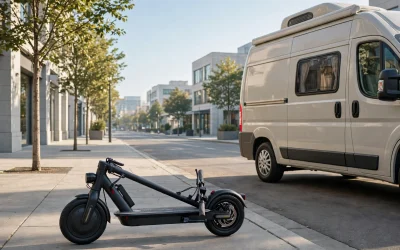
Folding is useful when a scooter travels in a campervan, but it should not outrank structural security. Test the folded dimensions against the actual storage bay, including the handlebar width. Some scooters fold at the stem but still have a long, awkward deck; others require removing the handlebar or using a strap.
Choose a model with a positive locking mechanism, a clearly visible release indicator, and little side-to-side movement when unfolded. Keep the folded scooter from rubbing against bicycles, tools, or metal storage walls. A simple fabric sleeve or foam wrap prevents scratches and keeps road grit away from the folding joint.
Durability and ownership costs
The parts most likely to wear are wheels, bearings, brake fenders, grips, and folding-joint hardware. A child who rides several times weekly may flatten or roughen wheels within one to three seasons, depending on pavement and rider weight. Replace wheels when they become visibly uneven, cracked, excessively small, or noticeably slow—not merely because the scooter looks dusty.
That is roughly 10–20 cents per ride, before considering the original scooter cost. The cheaper purchase is not always the cheaper ownership choice.
After dusty or wet trips, wipe the frame and dry the brake area. Do not hose bearings or leave the scooter wet in a closed van. Check axle nuts, headset movement, handlebar clamps, and brake clearance every few rides. Do not apply oil to polyurethane wheel surfaces or brake contact areas; it can reduce grip.
Buying checklist before you pay
- Confirm the rider’s current weight is comfortably below the stated limit; a margin of at least 10–15 kg is useful for stability and growth.
- Measure the child’s height and compare it with the manufacturer’s handlebar range.
- Check that both feet can fit naturally on the deck without touching the rear brake accidentally.
- Spin each wheel and listen for grinding, wobbling, or scraping.
- Apply the brake while rolling slowly; it should slow the scooter progressively rather than catch abruptly.
- Verify that the folding lock cannot release accidentally and that replacement wheels or brake parts are available.
- Pair every ride with a properly fitted helmet and, for beginners, consider wrist, elbow, and knee protection.
Bottom line
For most young beginners, the best kids scooters are stable three-wheel models with a low deck and moderate wheel size. Confident older children usually benefit from two wheels, a rear fender brake, and 145–180 mm wheels. Choose 180–230 mm wheels when smoother rolling and longer paved rides matter more than minimum weight. The right fit, a secure steering system, a usable brake, and regular checks will contribute more to safe, smooth riding than extra lights or a flashy finish.